publications
2026
-
 Deep learning-based machine vision system for real-time edge fracture detection in the hole expansion testVan Doi Truong and Jonghun YoonEngineering Applications of Artificial Intelligence, 2026
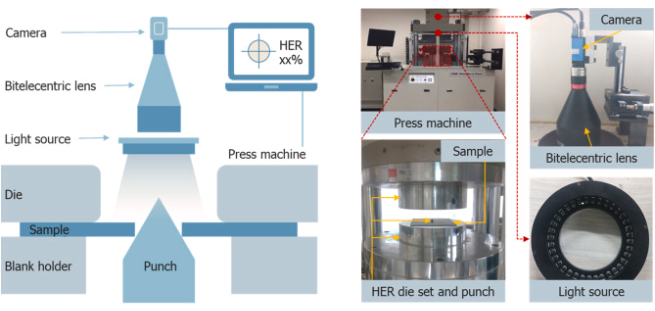
Edge fracture poses a critical challenge in sheet metal forming processes involving extruded holes, stretched flanges, or tight radius bends widely used in the automotive industry. Real-time detection of edge fractures in the hole expansion test, which is used to quantify the edge stretchability of sheet metal, has become both a technical challenge and an industrial necessity due to the diversity of materials. This study aims to develop an automated machine vision system for real-time detection of edge fractures and quantification of the hole expansion ratio during the hole expansion test. A deep learning-based vision pipeline is proposed, integrating dataset collection, dual-stage segmentation, and region-of-interest linearization to precisely capture the onset of cracks. This approach enables simultaneous recognizing edge fractures, quantifying the hole expansion ratio, and measuring crack gaps under varying surface reflectance and sheet thickness conditions. An ablation study evaluates the proposed approach against single-stage segmentation on the hole expansion test dataset prepared by hole punching method. Practical experimental validation confirms high segmentation accuracy and hole expansion ratio measurements with a maximum error of less than 2 % compared to manual evaluation. The findings offer a scalable and objective solution that overcomes the limitations of conventional monitoring methods and ensures consistent, real-time assessment across varying sheet materials.
-
 Deep learning prediction of weld bead geometry during multi-pass multi-layer welding processVan Doi Truong and Jonghun YoonEngineering Applications of Artificial Intelligence, 2026
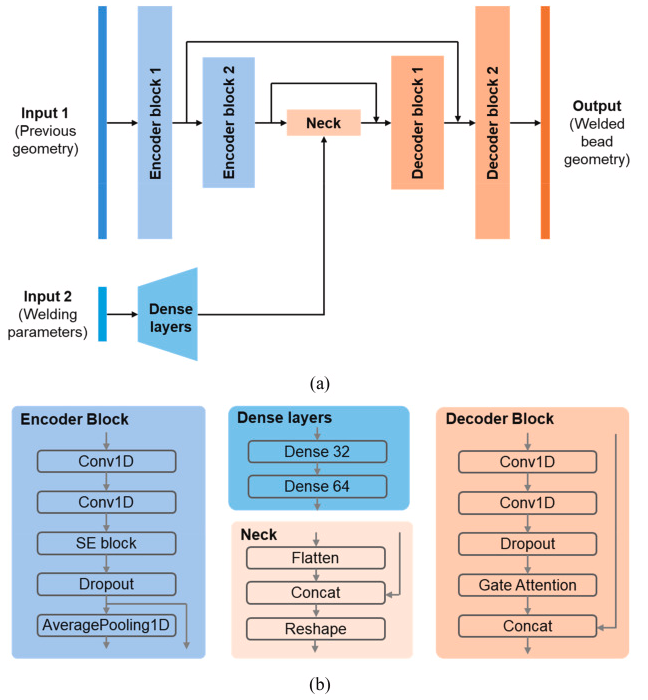
Accurate prediction of weld bead geometry is essential for optimizing welding procedure specifications in multi-layer, multi-pass welding. Most existing studies predict only limited geometric parameters such as bead width or height and usually assume a fixed initial shape, without considering variation in the input geometry or the influence of welding position. This work addresses these limitations by proposing a convolutional-neural-network-based method that predicts the full cross-sectional bead geometry for arbitrary initial geometries. A tip-referenced region-of-interest extraction technique is introduced to reduce geometric fluctuations. A comprehensive dataset was acquired using a line-scanner sensor through a series of welding experiments on three common materials to ensure dataset diversity. The model is evaluated against linear regression, random forest, and multilayer perceptron baselines, yielding a determination coefficient of 0.94 and a geometric overlap of 82.4% on the validation set. Analysis of the welding parameters indicates that bead-geometry dimensions generally exhibit a significant inverse relationship with travel speed, while showing positive correlations with wire-feed speed and welding currents. The model is successfully applied to predict welding geometry for multi-layer, multi-pass welding processes, demonstrating its potential as an effective tool for data-driven welding-procedure development.
2025
-
 A Deep Learning-Based Machine Vision System for Online Monitoring and Quality Evaluation During Multi-Layer Multi-Pass WeldingVan Doi Truong, Yunfeng Wang, Chanhee Won, and 1 more authorSensors (Basel, Switzerland), 2025
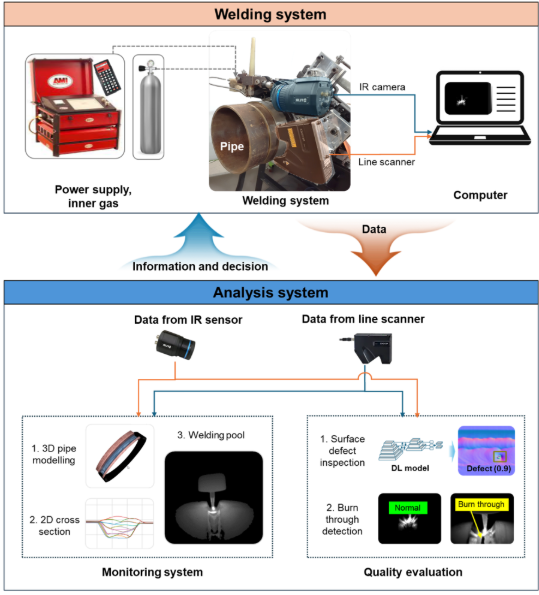
Multi-layer multi-pass welding plays an important role in manufacturing industries such as nuclear power plants, pressure vessel manufacturing, and ship building. However, distortion or welding defects are still challenges; therefore, welding monitoring and quality control are essential tasks for the dynamic adjustment of execution during welding. The aim was to propose a machine vision system for monitoring and surface quality evaluation during multi-pass welding using a line scanner and infrared camera sensors. The cross-section modelling based on the line scanner data enabled the measurement of distortion and dynamic control of the welding plan. Lack of fusion, porosity, and burn-through defects were intentionally generated by controlling welding parameters to construct a defect inspection dataset. To reduce the influence of material surface colour, the proposed normal map approach combined with a deep learning approach was applied for inspecting the surface defects on each layer, achieving a mean average precision of 0.88. In addition to monitoring the temperature of the weld pool, a burn-through defect detection algorithm was introduced to track welding status. The whole system was integrated into a graphical user interface to visualize the welding progress. This work provides a solid foundation for monitoring and potential for the further development of the automatic adaptive welding system in multi-layer multi-pass welding.
-
 Integrated Ultra-Wideband Microwave System to Measure Composition Ratio Between Fat and Muscle in Multi-Species Tissue TypesLixiao Zhou, Van Doi Truong, and Jonghun YoonSensors, 2025
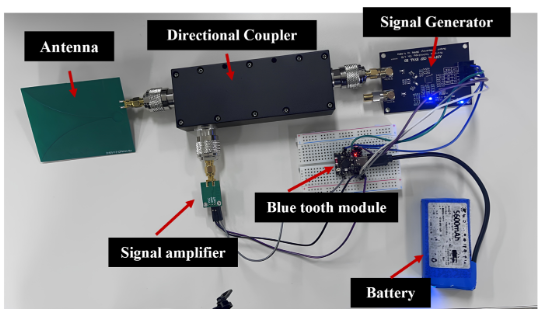
Accurate and non-invasive assessment of fat and muscle composition is crucial for biomedical monitoring to track health conditions in humans and pets, as well as for classifying meats in the meat industry. This study introduces a cost-effective, multifunctional ultra-wideband microwave system operating from 2.4 to 4.4 GHz, designed for rapid and non-destructive quantification of fat thickness, muscle thickness, and fat-to-muscle ratio in diverse ex vivo samples, including pork, beef, and oil–water mixtures. The compact handheld device integrates essential RF components such as a frequency synthesizer, directional coupler, logarithmic power detector, and a dual-polarized Vivaldi antenna. Bluetooth telemetry enables seamless real-time data transmission to mobile- or PC-based platforms, with each measurement completed in a few seconds. To enhance signal quality, a two-stage denoising pipeline combining low-pass filtering and Savitzky–Golay smoothing was applied, effectively suppressing noise while preserving key spectral features. Using a random forest regression model trained on resonance frequency and signal-loss features, the system demonstrates high predictive performance even under limited sample conditions. Correlation coefficients for fat thickness, muscle thickness, and fat-to-muscle ratio consistently exceeded 0.90 across all sample types, while mean absolute errors remained below 3.5 mm. The highest prediction accuracy was achieved in homogeneous oil–water samples, whereas biologically complex tissues like pork and beef introduced greater variability, particularly in muscle-related measurements. The proposed microwave system is highlighted as a highly portable and time-efficient solution, with measurements completed within seconds. Its low cost, ability to analyze multiple tissue types using a single device, and non-invasive nature without the need for sample pre-treatment or anesthesia make it well suited for applications in agri-food quality control, point-of-care diagnostics, and broader biomedical fields.
-
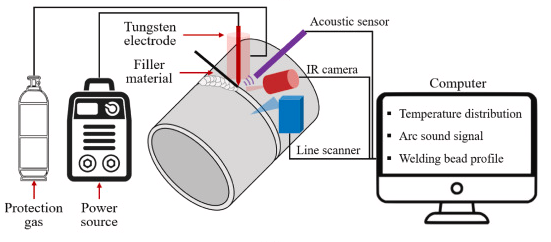 Ensemble machine learning model for prediction of inner welding defects in orbital GTAW (Gas Tungsten Arc Welding) process with monitored by multi-sensor systemYuHyeong Jeong, Yunfeng Wang, Van Doi Truong, and 3 more authorsInternational Journal of Pressure Vessels and Piping, 2025
This study proposes a novel real-time defect detection system based on multi-sensor fusion, integrating an infrared (IR) camera, a laser line scanner, and an acoustic sensor to monitor welding conditions during the GTAW process for carbon steel and stainless steel. Sensor data are processed to extract thermal, geometrical, and acoustic features, which are used to train two sub–machine learning models based on artificial neural networks (ANN) for detecting porosity and lack of fusion defects. The sub-model outputs are combined into an ensemble model achieving an average accuracy of 94.3 % in K-fold cross validation, but this restricts applicability to carbon/stainless steel welds unless retrained. The system can predict defects within approximately 10 s after welding, reducing inspection time by about 30 times compared to conventional X-ray methods, enabling substantial improvements in industrial process efficiency. The proposed approach offers a distinct advantage over prior single-sensor systems by combining complementary thermal, and acoustic sub-machine learning model into a unified predictive model, enabling not only defect detection but also accurate classification of defect types.
2024
-
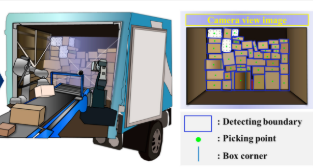 Revolutionizing Robotic Depalletizing: AI-Enhanced Parcel Detecting with Adaptive 3D Machine Vision and RGB-D Imaging for Automated UnloadingSeongje Kim, Van-Doi Truong, Kwang-Hee Lee, and 1 more authorSensors, 2024
Detecting parcels accurately and efficiently has always been a challenging task when unloading from trucks onto conveyor belts because of the diverse and complex ways in which parcels are stacked. Conventional methods struggle to quickly and accurately classify the various shapes and surface patterns of unordered parcels. In this paper, we propose a parcel-picking surface detection method based on deep learning and image processing for the efficient unloading of diverse and unordered parcels. Our goal is to develop a systematic image processing algorithm that emphasises the boundaries of parcels regardless of their shape, pattern, or layout. The core of the algorithm is the utilisation of RGB-D technology for detecting the primary boundary lines regardless of obstacles such as adhesive labels, tapes, or parcel surface patterns. For cases where detecting the boundary lines is difficult owing to narrow gaps between parcels, we propose using deep learning-based boundary line detection through the You Only Look at Coefficients (YOLACT) model. Using image segmentation techniques, the algorithm efficiently predicts boundary lines, enabling the accurate detection of irregularly sized parcels with complex surface patterns. Furthermore, even for rotated parcels, we can extract their edges through complex mathematical operations using the depth values of the specified position, enabling the detection of the wider surfaces of the rotated parcels. Finally, we validate the accuracy and real-time performance of our proposed method through various case studies, achieving mAP (50) values of 93.8% and 90.8% for randomly sized and rotationally covered boxes with diverse colours and patterns, respectively.
-
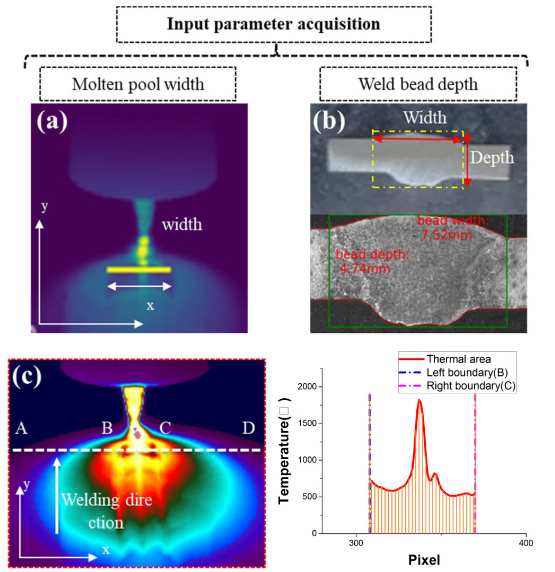 Prediction of internal welding penetration based on IR thermal image supported by machine vision and ANN-model during automatic robot welding processYunfeng Wang, Wonjoo Lee, Seungbeom Jang, and 5 more authorsJournal of Advanced Joining Processes, 2024
Welding quality is a critical criterion for evaluating welding operations. Traditional evaluation methods suffer from drawbacks such as lack of objectivity, untimeliness, and high costs. Therefore, real-time monitoring and assessment of the weld pool have become the mainstream trend in welding technology. This study introduces a novel method for defining weld pool width boundaries. It utilizes an infrared (IR) camera to capture the weld pool temperature clusters and employs the Sobel operator for convolution to generate the gradient map of the weld pool temperature clusters. Through enhanced processing in the gradient map, the width boundaries of the weld pool are more effectively detected compared to previous methods. Previous studies defined weld pool width boundaries by identifying characteristic points with the most distinct temperature fluctuations, caused by the different radiative properties of the same material in different states. However, practical tests revealed susceptibility to interference from reflected arc light. The proposed method mitigates the impact of reflected arc light and is applicable to complex multilayer welding scenarios. To address the lag in quality monitoring, reduce welding costs, and achieve real-time monitoring of the weld pool process, we employed machine vision and an artificial neural network (ANN) model. This led to the development of a weld penetration assessment system based on infrared thermal images. The system successfully predicted the penetration depth for 4 mm carbon steel with an accuracy of 86.6 %. This validates the feasibility of estimating and predicting weld performance using the surface temperature characteristics of the weld pool. The newly proposed weld pool boundary definition method holds promise for real-time monitoring in more complex multilayer pipe welding scenarios. It lays the groundwork for predicting and fusing the weld depth in intricate multi-pass pipe welding.
-
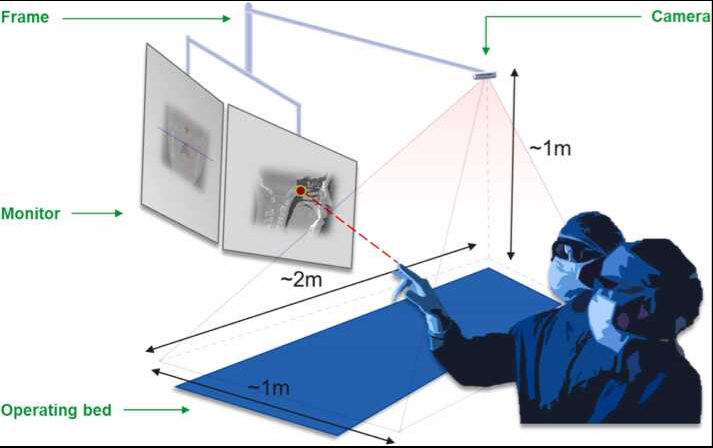 Contagious infection-free medical interaction system with machine vision controlled by remote hand gesture during an operationVan Doi Truong, Hyun-Kyo Lim, Seongje Kim, and 2 more authorsComputational and Structural Biotechnology Journal, 2024
Background and objective: Medical image visualization is a requirement in many types of surgery such as orthopaedic, spinal, thoracic procedures or tumour resection to eliminate risk such as "wrong level surgery". However, direct contact with physical devices such as mice or touch screens to control images is a challenge because of the potential risk of infection. To prevent the spread of infection in sterile environments, a contagious infection-free medical interaction system has been developed for manipulating medical images. Methods: We proposed an integrated system with three key modules: hand landmark detection, hand pointing, and hand gesture recognition. A proposed depth enhancement algorithm is combined with a deep learning hand landmark detector to generate hand landmarks. Based on the designed system, a proposed hand-pointing system combined with projection and ray-pointing techniques allows for reducing fatigue during manipulation. A proposed landmark geometry constraint algorithm and deep learning method were applied to detect six gestures including click, open, close, zoom, drag, and rotation. Additionally, a control menu was developed to effectively activate common functions. Results: The proposed hand-pointing system allowed for a large control range of up to 1200 mm in both vertical and horizontal direction. The proposed hand gesture recognition method showed high accuracy of over 97% and real-time response. Conclusion: This paper described the contagious infection-free medical interaction system that enables precise and effective manipulation of medical images within the large control range, while minimizing hand fatigue.
2023
-
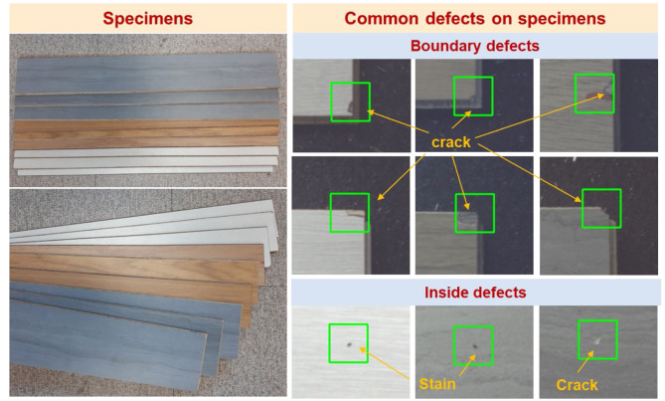 An automatic machine vision-based algorithm for inspection of hardwood flooring defects during manufacturingVan Doi Truong, Jiaping Xia, YuHyeong Jeong, and 1 more authorEngineering Applications of Artificial Intelligence, 2023
Hardwood flooring products are popular construction materials because of their aesthetics, durability, low maintenance requirements, and affordability. To ensure product quality during manufacturing, common defects such as cracks, chips, or stains are typically detected and classified manually, but this process can decrease productivity. The aim of this study was to develop an automatic machine vision-based inspection system with a robust algorithm for inspecting small hardwood flooring defects in a production line. This defect-inspection algorithm is based on image-processing techniques, including background elimination, boundary approximation, and defect inspection of photographs. The YOLOv5 deep-learning algorithm for object detection was applied to detect surface defects. The resulting algorithm identified the quality of each specimen (i.e., either good or defective). The influences of colour and surface patterns on defect inspection were experimentally investigated under light conditions. The algorithm was adaptable to specimens with different colours and patterns under various conditions, demonstrating the potential of this approach in practical situations.
2022
-
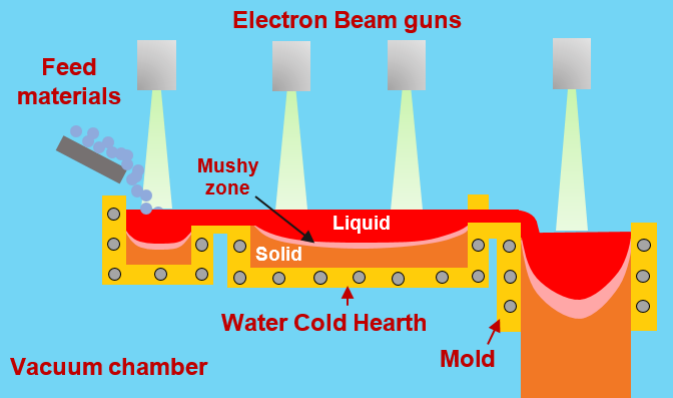 Numerical simulation of the effects of scanning strategies on the aluminum evaporation of titanium alloy in the electron beam cold hearth melting processVan-Doi Truong, Yong-Taek Hyun, Jong Woo Won, and 2 more authorsMaterials, 2022
In the production of titanium alloy, the electron beam cold hearth melting (EBCHM) process is commonly used due to its effectiveness and the high quality of the end product. However, its main drawback is the significant loss of elements such as aluminum (Al) due to evaporation under the vacuum environment. Numerical coupled thermal-flow models were here developed to investigate the effects of scanning strategies on Al loss in a titanium alloy during EBCHM. The validation model was successful in comparison with previously published experimental data. The Al mass fraction results at the outlet of the water-cooled hearth were strongly influenced by changes in the applied scanning strategies. The results indicated that the Al mass fraction loss could be reduced by using the full-hearth scanning strategies.